


Knowing what the Employment Leave Bill changes is one thing. Knowing what to do about it is another.
Most organisations understand that significant legislation is coming. Fewer have a clear picture of what the transition actually involves, how many systems it touches, how many teams it affects, and how much time it genuinely takes to do well. The organisations that underestimate the scope will find themselves managing a compliance crisis rather than a structured programme. The ones that get ahead of it will emerge with cleaner systems, more accurate payroll, and genuine delivery confidence.
This article is for the teams responsible for making the transition happen: payroll leads, HR directors, technology managers, programme managers, and the executives sponsoring the work. It covers what good preparation looks like, where organisations typically get it wrong, and how to build a delivery structure that gives your team the visibility and governance to transition confidently and on time. While the context here is the Employment Leave Bill, the delivery framework we describe applies equally to any complex organisational change programme.
At a glance:
- This is expected to be a programme-scale change, not simply a payroll update.
- The Bill has passed its second reading and is now before the Committee of the Whole House.
- Employment agreements are high impact, due to union involvement and existing collective agreements.
- Converting leave balances to hours and above-entitlement arrangements is complex and time-consuming.
- Most vendors are unlikely to publish detailed roadmaps until the legislation is finalised.
This Is a Programme, Not a Patch
Here is the reality that many organisations are not yet facing: the Employment Leave Bill, if enacted in its current form, is not a payroll update. It is a programme. Treat it like a payroll update and you risk underestimating the scope, under-resourcing the delivery, and managing a compliance crisis rather than a structured transition.
Think about what a mid-sized organisation running 300 employees across full-time, part-time, and casual arrangements is actually dealing with. Your payroll system is currently configured to calculate leave in days and weeks, apply multiple leave payment calculation methods, track annual leave from each employee’s anniversary date, and assess public holiday eligibility using a subjective, factors-based test. Most of these configurations are expected to change if the Bill is enacted in its current form, at the same time, in a coordinated way, without disrupting payroll runs for your people.
That requires project governance: system readiness assessment, stakeholder alignment, vendor engagement, parallel testing, and a structured cutover plan. The organisations that navigate this well are not necessarily the largest or most technically sophisticated. They are the ones that recognise what this is and resource it accordingly.
The Two-Year Window: Why Your Preparation Starts Now
It is important to be clear about what preparation means at this stage. The Employment Leave Bill has passed its second reading and is now before the Committee of the Whole House, with a third reading still to come. It has not yet received Royal Assent, and its provisions may still change before then. Most vendors are unlikely to publish detailed development roadmaps until the legislation is finalised, and some system changes cannot be confirmed until then either. What you can do now is assess your current state, identify your gaps, open conversations with your vendors, and build the internal structure you will need to move quickly once the legislation is finalised. Preparing is not the same as acting on changes that are not yet confirmed.
If enacted in its current form, the main provisions are expected to commence two years after Royal Assent. With that in mind, two years still sounds like a long time. It may not be, for two specific reasons.
High impact: employment agreements. Under the Bill as reported back from Select Committee, employers would have until one year after commencement to ensure relevant employment agreements comply with the new framework. During that first year, employers would need to comply with both the agreement and the new Act, with any more favourable contractual term prevailing. While this provides some additional time, agreements may still need to be reviewed for standard-hours arrangements, leave accrual and payment provisions, public holidays, cashing up, closedowns, and above-minimum entitlements. Where collective agreements need to be amended, bargaining and consultation may take time, so beginning this review during the 24-month implementation period will reduce the risk of conflicting contractual and statutory requirements after commencement.
High complexity: balance conversion and above-entitlement arrangements. Beyond system reconfiguration, converting existing leave balances to hours is not a straightforward calculation. Employees may hold balances accrued under different entitlement rules over time, and some will have above-entitlement arrangements defined in their employment agreements, such as an extra week of annual leave, or long service leave paid at annual leave rates. Where employment agreement interpretation is required, appropriate legal advice should be obtained. This is work that needs to start well before your system build begins, and it is easy to underestimate how long it takes to get right.
Beyond those two areas, here is what else is expected to sit inside the two-year window. Payroll vendors are expected to undertake significant product changes to support the new framework. Your HRIS platform is likely to need reconfiguration, testing, and validation. Your payroll and HR teams will need to be trained on new rules, new processes, and new system logic. If you run a complex workforce with multiple entities, variable hours, and casual arrangements, your transition will take longer and require more coordination than a simpler structure would.
Start with a readiness assessment now, ahead of Royal Assent. Understand what your current systems can and cannot do. Open the conversation with your vendors while they still have capacity to think about your priorities rather than manage a post-Assent backlog. Establish your programme structure in the first three months of your own planning, not the last three months before the deadline.
Organisations that begin now are more likely to have options: influence over their vendor’s roadmap, time to run parallel systems before cutover, and the space to catch errors in testing rather than in a live payroll run. Organisations that wait are more likely to face fewer of them, showing up in remediation, in errors, and in the kind of last-minute pressure that puts your people and your compliance at risk.
This Is a Programme, Not a Patch
We have sat in enough post-mortems to know what tends to separate a smooth regulatory transition from a painful one. It is rarely about the technology, and rarely about the legislation being too complex. It comes down to three things: clarity of scope, early stakeholder engagement, and structured delivery governance.
- Clarify your current state first. Before you can plan the transition, you need to understand exactly where you are starting from. Document how your payroll system currently calculates leave, every rule, every configuration, every exception. Include your above-entitlement arrangements and any contractual leave provisions that sit outside the standard framework. This baseline is not optional. Without it, every decision you make about the transition is built on assumptions rather than evidence, and assumptions are expensive to correct mid-programme.
- Engage your vendors before they are busy. Your payroll and HRIS vendors are already working through the implications of the Bill, and they are managing interest from many clients simultaneously. Most vendors are unlikely to publish detailed roadmaps until the legislation is finalised, but early conversations still matter. They help you understand your vendor’s thinking, signal your organisation’s intent, and position you to act quickly once Royal Assent lands. Vendor capacity is finite. Organisations that have already opened the conversation tend to be better placed when the build phase begins.
- Build a delivery structure that matches the complexity. This is not a project for one person to carry alongside their regular role. It needs clear ownership, defined workstreams, and regular governance checkpoints. Even a lightweight structure, a steering group, a fortnightly rhythm, and a simple RAID log, tends to pay for itself in reduced rework, reduced remediation risk, and a smoother cutover than you would otherwise have.
In one engagement, we worked alongside a client facing a similarly complex regulatory transition. Within the first month, we embedded a governance framework across their HR, payroll, and technology teams. Within twelve weeks, they had a clear gap analysis, an agreed delivery roadmap, and a tested implementation plan, allowing sufficient time for testing before the compliance deadline, and without the last-minute pressure that had defined every previous change programme in their organisation.
If enacted in its current form, the Employment Leave Bill represents a similar opportunity. Approached as a programme, organisations are more likely to come out the other side with cleaner systems, more accurate payroll, and genuine delivery confidence.
A note on timelines below: the table sets out what a complex, full-scale implementation can look like. Not every organisation will need the full 24 months, your actual timeline depends on workforce size, the complexity of your employment arrangements, and how ready your current systems already are.
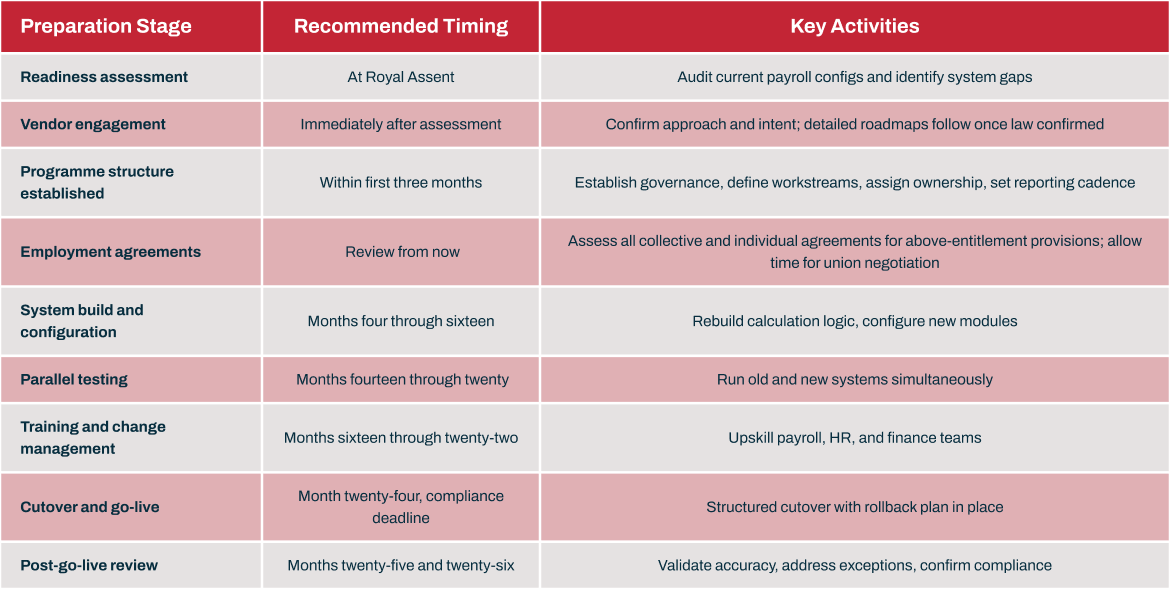
Note: the table sets out what a complex, full-scale implementation can look like. Not every organisation will need the full 24 months, your actual timeline depends on workforce size, the complexity of your employment arrangements, and how ready your current systems already are.
How Alxemy Can Help
Alxemy works alongside clients, legal advisors, and software vendors to translate legislative requirements into practical payroll, HRIS, and workforce management solutions. From readiness assessment to go-live, we bring the structure, governance, and delivery experience to help make your Employment Leave Bill transition a programme your organisation can be proud of.
Book a readiness assessment with the Alxemy team and get a clear picture of where your organisation stands before the compliance clock starts ticking.
What Comes Next
This series has covered the key legislative changes, what good preparation looks like in practice, and the detail beneath the surface, including how parental leave is handled under the new framework.
If enacted in its current form, the main provisions of the Employment Leave Bill are expected to commence two years after Royal Assent. The parental leave payment provisions administered by IRD sit on a separate, tighter timeline: if enacted, these are expected to apply to parental leave payment applications received on or after 1 July 2027, ahead of the broader framework.
If you are ready to take the next step, we are here to help.
Ready to prepare your organisation for the Employment Leave Bill? Talk to Alxemy today.
Key Takeaways:
- This is expected to be a programme, not a patch. The Employment Leave Bill, if enacted in its current form, touches every layer of your payroll, HRIS, and workforce management systems. Treat it with the governance and structure it deserves.
-
The Bill is not yet law. Preparation now means assessment, gap analysis, and internal readiness, not locking in changes that are not yet confirmed.
- Review employment agreements early. Contractual changes and collective bargaining can extend implementation timelines.
- Balance conversion and above-entitlement arrangements require careful analysis. Converting existing leave balances to hours, and handling contractual provisions that go beyond the standard framework, is some of the most complex work in this transition. Start early.
- While the Bill aims to simplify ongoing leave administration, the transition itself will be a significant payroll and HRIS change programme. Each improvement, from a consistent hourly leave payment method to day-one accrual, requires deliberate, coordinated action from your payroll, HR, and technology teams.
Disclaimer: This article provides general information only and should not be relied on as legal advice. Organisations should obtain independent legal advice when reviewing employment agreements or determining their legal obligations under employment legislation.