

Employment Leave Bill: What You Can Do Now

Employment Leave Bill: What You Can Do Now

What to do now?

The Employment Leave Bill is making its way through Parliament and, while it has not yet passed into law by receiving Royal Assent, there are practical steps organisations can take now to prepare.

Taking action early can help ensure the right foundations are in place should the Bill become law, reducing the risk of rushed decisions, system disruption, and compliance challenges later.

This article outlines some of the key actions employers can take now to assess readiness and begin planning for change.


Identify Standard Working Hours for Your Employees

The basis of the Employment Leave Bill is that leave is accrued based on standard working hours.

These are defined as the hours an employee is required to work under their employment agreement and for which the employer must pay them. Leave accrual continues during periods of paid leave, parental leave, volunteer leave, and jury leave, but not during periods of unpaid leave.

If there are no standard hours, the employee and employer can agree on a notional roster.

What to do now: Start looking at your rosters. Identify where hours may need to be further defined, or where a notional roster may be needed.

Identify Additional Hours

Additional hours are hours worked over and above an employee’s standard hours.

This is where the agreement of standard working hours becomes important. Hours worked above standard will need to be paid at the base hourly rate plus 12.5%. This rate of pay is referred to as the Leave Compensation Payment (LCP).

An employer and employee can also agree to accrue PAL, Purported Annual Leave. This relates to an employer’s liability where leave is accrued instead of the employee receiving LCP.

Casual Employees

Consider reviewing your casual employees,  are these genuine casuals?

Once the Employment Leave Bill becomes law, casuals will be paid the LCP rate of 12.5% on worked hours, rather than the current 8%. Alternatively, casual employees can accrue Purported Annual Leave as above.

Definition of Otherwise Working Day

Currently there is no definition of otherwise working day (OWD) within the Holidays Act. This has resulted in ambiguity around how to determine whether a public holiday was an otherwise working day for an employee.

The Employment Leave Bill sets the determination of OWD as an employee having worked on the same day of the week on at least 50% of the last 13 weeks.

Because there is no current legislation to adhere to regarding OWD, this is one of the few areas where you can configure your system now, and have the determination in place when the Bill becomes law.

What to do now: Check whether your system can automate this. If not, why not?

Parental Leave Changes

The proposed changes to parental leave will be effective for any parental leave applications on or after 1 July 2027.

This is the one change that is not effective two years after Royal Assent, it applies in a shorter timeframe. This means the configuration for parental leave will need to be updated sooner than the rest of the Bill’s provisions, and will need to work alongside the current provisions of the Holidays Act during the two years after Royal Assent.

More Detail Coming: A follow-up article on the details of the parental leave changes is coming soon.

Provision of Pay Statements

Once the new Act is in place, there will be a legislative requirement to provide employees with pay statements.

This has not been in legislation before, but it is considered best practice and most payroll systems already provide payslips. However, with the Bill defining what must appear on a pay statement, it is worth checking what your current payslip includes, and working with your software provider to add anything that is missing now.

Refer to section 130A of the Bill for the full requirements.

Obfuscation of Family Violence Leave

The Bill introduces a change to how family violence leave is recorded on pay statements.

Many organisations already obfuscate the term on payslips, but this will now be legislated. Family violence leave will need to be recorded as a non-identifiable component of the employee’s pay.

What to do now: If your system is not already doing this, now is a good time to make the change.

Remediation Under the Holidays Act 2003

Schedule 3 of the Employment Leave Bill makes provisions for a remediation process under the Holidays Act.

This means that if the Employment Leave Bill becomes law, employers cannot avoid their obligations under the Holidays Act 2003 while waiting for the Employment Leave Act to come into effect. If your system is not currently compliant with the Holidays Act, that still needs to be addressed now.

The Employment Leave Bill becoming law will not protect you from a future remediation process.

And yes, once you have addressed your Holidays Act compliance, you will then need to change again when the Employment Leave Act comes into force. However, the Employment Leave Bill does detail the calculations required to convert weeks and days into hours.

Important: If your system is not already operating in weeks and days, you will be in contravention of this part of the Bill. You will not be starting from the same platform required for the conversion as stated in the Bill.

Ready before the Bill lands?

Whether you are working through rosters, reviewing casual arrangements, or trying to understand what the Employment Leave Bill means for your systems and people, Alxemy can help you work through it.

If you would like to talk through where your organisation stands, we are happy to have that conversation.

Talk to our team  View Payroll Services


In Summary

Waiting for the Employment Leave Bill to become law before you act is not a strategy. It is a risk.

The time to get your systems, rosters, and processes in order is now, while you still have the runway to do it properly.

The changes introduced by the Bill are significant. Leave accrual based on standard hours, Leave Cash-up Payment (LCP) on additional hours, a legislated Ordinary Working Day (OWD) test, and parental leave changes effective from 1 July 2027 all carry system, process, and people implications that take time to work through.

For organisations carrying Holidays Act non-compliance into this transition, the stakes are even higher. The Bill makes it clear that past obligations remain. Remediation is not optional, and the Employment Leave Act coming into force will not change that.

The organisations that navigate this transition well will be those that start early, stay informed, and treat preparation as an ongoing discipline rather than a last-minute project.

If you have not yet read Article 1: Holidays Act 2003 vs Employment Leave Bill: What Is Actually Changing, start there for a grounding in the key reforms.

In Article 3 of this series, we will take a closer look at the proposed parental leave changes and what they may mean for employers, payroll teams, and employees.

Ready to prepare your organisation for the Employment Leave Bill? Talk to Alxemy today.


Key Takeaways:

  • Standard working hours — Review your rosters now and identify where hours need to be defined or where a notional roster may be required
  • Additional hours — Hours worked above standard will attract a Leave Compensation Payment (LCP) of 12.5% on top of the base hourly rate
  • Casual employees — Review whether your casuals are genuine. The LCP rate moves from 8% to 12.5% once the Bill becomes law
  • Otherwise Working Day (OWD) — One of the few areas you can configure your system now. The test is 50% of the same day worked across the last 13 weeks
  • Parental leave payment changes — Certain provisions apply from 1 July 2027, sooner than the broader Employment Leave reforms. Configuration and payroll readiness will need to happen ahead of the wider transition.
  • Pay statements — Check your current payslip against section 130A of the Bill and work with your provider to close any gaps now
  • Family violence leave — Must be recorded as a non-identifiable component on pay statements. If your system is not doing this already, change it now

How to Prepare Your Organisation for the Employment Leave Act 2026

How to Prepare Your Organisation for the Employment Leave Act 2026

<br />
Employment Leave Bill</p>
<p>

Knowing what the Employment Leave Act 2026 changes is one thing. Knowing what to do about it is another.

Most organisations understand that significant change is coming. Fewer have a clear picture of what the transition actually involves, how many systems it touches, how many teams it affects, and how much time it genuinely takes to do well. The organisations that underestimate the scope will find themselves managing a compliance crisis rather than a structured programme. The ones that get ahead of it will emerge with cleaner systems, more accurate payroll, and genuine delivery confidence.

This article is for the teams responsible for making the transition happen: payroll leads, HR directors, technology managers, programme managers, and the executives sponsoring the work. It covers what good preparation looks like, where organisations typically get it wrong, and how to build a delivery structure that gives your team the visibility and governance to transition confidently and on time. While the context here is the Employment Leave Act 2026, the delivery framework we describe applies equally to any complex organisational change programme.

At a glance:

  • This is a programme-scale change, not simply a payroll update.
  • The Employment Leave Act 2026 received Royal Assent on 6 August 2026 and willtake effect on 6 August 2028.
  • Employment agreements are high impact, due to union involvement and existing collective agreements.
  • Converting leave balances to hours and above-entitlement arrangements is complex and time-consuming.
  • Payroll and HRIS vendors can now finalise their development roadmaps against the
    enacted legislation.

This Is a Programme, Not a Patch

Here is the reality that many organisations are not yet facing: the Employment Leave Act 2026 is not a payroll update. It is a programme. Treat it like a payroll update and you risk underestimating the scope, under-resourcing the delivery, and managing a compliance crisis rather than a structured transition.

Think about what a mid-sized organisation running 300 employees across full-time, part-time, and casual arrangements is actually dealing with. Your payroll system is currently configured to calculate leave in days and weeks, apply multiple leave payment calculation methods, track annual leave from each employee’s anniversary date, and assess public holiday eligibility using a subjective, factors-based test. Most of these configurations will need to change to support the Employment Leave Act 2026, at the same time, in a coordinated way, without disrupting payroll runs for your people.

That requires project governance: system readiness assessment, stakeholder alignment, vendor engagement, parallel testing, and a structured cutover plan. The organisations that navigate this well are not necessarily the largest or most technically sophisticated. They are the ones that recognise what this is and resource it accordingly.

The Two-Year Window: Why Your Preparation Starts Now

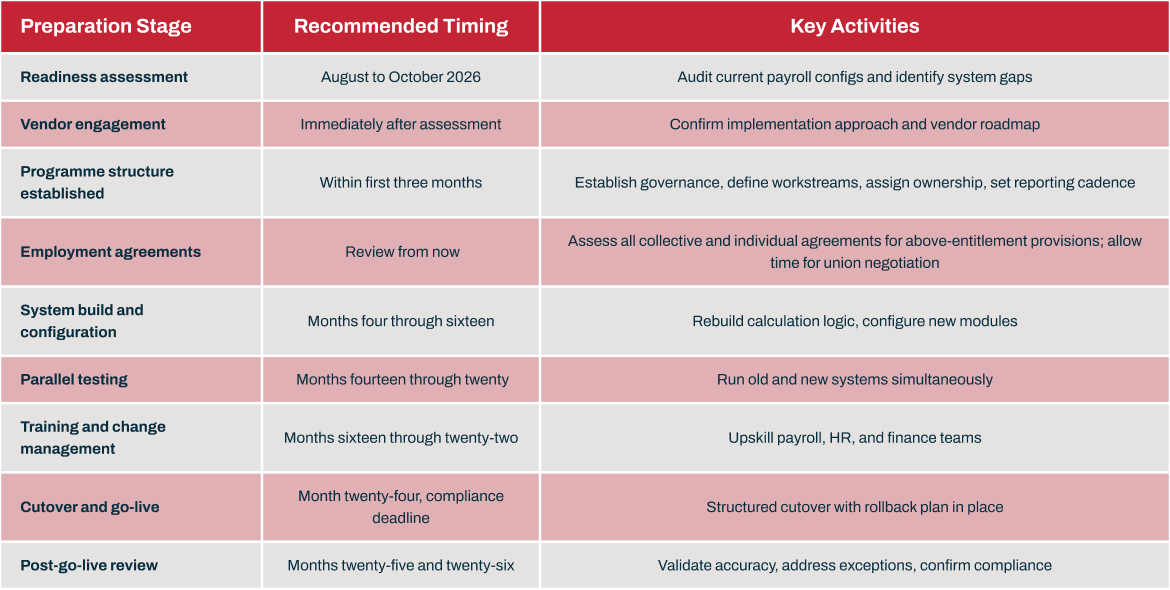
It is important to be clear about what preparation means at this stage. The Employment Leave Act 2026 received Royal Assent on 6 August 2026 and its substantive leave framework will take effect on 6 August 2028. Until then, employers must continue to comply with the Holidays Act 2003 and cannot apply the new rules early. The two-year implementation period is the time to assess your current state, identify your gaps, engage with vendors, and build the internal structure needed to complete the transition confidently and on time.

The substantive provisions will commence on 6 August 2028, two years after Royal Assent. With that in mind, two years still sounds like a long time. It may not be, for two specific reasons.

High impact: employment agreements. Under the Employment Leave Act 2026, employers will have until one year after commencement to ensure relevant existing employment agreements comply with the new framework. During that first year, employers will need to comply with both the agreement and the new Act, with any more favourable contractual term prevailing. While this provides some additional time, agreements may still need to be reviewed for standard-hours arrangements, leave accrual and payment provisions, public holidays, cashing up, closedowns, and above-minimum entitlements. Where collective agreements need to be amended, bargaining and consultation may take time, so beginning this review during the 24-month implementation period will reduce the risk of conflicting contractual and statutory requirements after commencement.

High complexity: balance conversion and above-entitlement arrangements. Beyond system configuration, converting existing leave balances to hours is not a straightforward calculation. Employees may hold balances accrued under different entitlement rules over time, and some will have above-entitlement arrangements defined in their employment agreements, such as an extra week of annual leave, or long service leave paid at annual leave rates. Where employment agreement interpretation is required, appropriate legal advice should be obtained. This is work that needs to start well before your system build begins, and it is easy to underestimate how long it takes to get right.

Beyond those two areas, here is what else sits inside the two-year implementation window. Payroll vendors will need to undertake significant product changes to support the new framework. Your HRIS platform is likely to need reconfiguration, testing, and validation. Your payroll and HR teams will need to be trained on new rules, new processes, and new system logic. If you run a complex workforce with multiple entities, variable hours, and casual arrangements, your transition will take longer and require more coordination than a simpler structure would.

Start with a readiness assessment now. Understand what your current systems can and cannot do. Open the conversation with your vendors while they still have capacity to think about your priorities rather than manage an implementation backlog. Establish your programme structure in the first three months of your own planning, not the last three months before the deadline.

Organisations that begin now are more likely to have options: influence over their vendor’s roadmap, time to run parallel systems before cutover, and the space to catch errors in testing rather than in a live payroll run. Organisations that wait are more likely to face fewer of them, showing up in remediation, in errors, and in the kind of last-minute pressure that puts your people and your compliance at risk.

What Good Preparation Looks Like

We have sat in enough post-mortems to know what tends to separate a smooth regulatory transition from a painful one. It is rarely about the technology, and rarely about the legislation being too complex. It comes down to three things: clarity of scope, early stakeholder engagement, and structured delivery governance.

  • Clarify your current state first. Before you can plan the transition, you need to understand exactly where you are starting from. Document how your payroll system currently calculates leave, every rule, every configuration, every exception. Include your above-entitlement arrangements and any contractual leave provisions that sit outside the standard framework. This baseline is not optional. Without it, every decision you make about the transition is built on assumptions rather than evidence, and assumptions are expensive to correct mid-programme.
  • Engage your vendors before they are busy. Your payroll and HRIS vendors are now working through the implementation requirements of the Employment Leave Act 2026, and they are managing interest from many clients simultaneously. Detailed roadmaps may take time to emerge, but early conversations still matter. They help you understand your vendor’s thinking, signal your organisation’s intent, and position you to act quickly as the build phase begins. Vendor capacity is finite. Organisations that have already opened the conversation tend to be better placed when demand increases.
  • Build a delivery structure that matches the complexity. This is not a project for one person to carry alongside their regular role. It needs clear ownership, defined workstreams, and regular governance checkpoints. Even a lightweight structure, a steering group, a fortnightly rhythm, and a simple RAID log, tends to pay for itself in reduced rework, reduced remediation risk, and a smoother cutover than you would otherwise have.

In one engagement, we worked alongside a client facing a similarly complex regulatory transition. Within the first month, we embedded a governance framework across their HR, payroll, and technology teams. Within twelve weeks, they had a clear gap analysis, an agreed delivery roadmap, and a tested implementation plan, allowing sufficient time for testing before the compliance deadline, and without the last-minute pressure that had defined every previous change programme in their organisation.

The Employment Leave Act 2026 represents a similar opportunity. Approached as a programme, organisations are more likely to come out the other side with cleaner systems, more accurate payroll, and genuine delivery confidence.

A note on timelines below: the table sets out what a complex, full-scale implementation can look like. Not every organisation will need the full 24 months, your actual timeline depends on workforce size, the complexity of your employment arrangements, and how ready your current systems already are.

How to prep for employment leave bill

  Alxemy Can Help


Alxemy works alongside clients, legal advisors, and software vendors to translate legislative requirements into practical payroll, HRIS, and workforce management solutions. From readiness assessment to go-live, we bring the structure, governance, and delivery experience to help make your Employment Leave Act transition a programme your organisation can be proud of.

Book a readiness assessment with the Alxemy team and get a clear picture of where your organisation stands while there is still time to plan, build, test, and transition with confidence.

Contact Us


What Comes Next

This series has covered the key legislative changes, what good preparation looks like in practice, and the detail beneath the surface, including how parental leave is handled under the new framework.

The substantive provisions of the Employment Leave Act 2026 will commence on 6 August 2028. Until then, the Holidays Act 2003 continues to apply, including employers’ obligations to address historical non-compliance and underpayments. Employers cannot begin applying the new leave rules early.

If you are ready to take the next step, we are here to help.

Ready to prepare your organisation for the Employment Leave Act 2026?  Talk to Alxemy today.

Key Takeaways:

  • This is a programme, not a patch. The Employment Leave Act 2026 touches
    every layer of your payroll, HRIS, and workforce management systems. Treat it
    with the governance and structure it deserves.
  • The Employment Leave Act 2026 is now law and takes effect on 6 August 2028. Preparation now means assessment, gap analysis, vendor engagement,
    system planning, and internal readiness while continuing to comply with the
    Holidays Act 2003.
  • Review employment agreements early. Contractual changes and collective bargaining can extend implementation timelines.
  • Balance conversion and above-entitlement arrangements require careful analysis. Converting existing leave balances to hours, and handling contractual provisions that go beyond the standard framework, is some of the most complex work in this transition. Start early.
  • While the Employment Leave Act 2026 aims to simplify ongoing leave
    administration, the transition itself will be a significant payroll and HRIS
    change programme. Each improvement, from a consistent hourly leave
    payment method to day-one accrual, requires deliberate, coordinated action
    from your payroll, HR, and technology teams.

Disclaimer: This article provides general information only and should not be relied on as legal advice. Organisations should obtain independent legal advice when reviewing employment agreements or determining their legal obligations under employment legislation.

Introducing the Employment Leave Bill: A New Framework for Leave in New Zealand

Introducing the Employment Leave Bill: A New Framework for Leave in New Zealand

<br />
Holidays Act 2003 vs Employment Leave Bill

The Employment Leave Bill represents one of the most significant reforms to New Zealand’s leave legislation in decades. Replacing the Holidays Act 2003, it introduces a new framework designed to be simpler, clearer, and more consistent across different working arrangements.

For many organisations, the current Holidays Act has proven difficult to interpret and even harder to implement correctly. The result has been widespread compliance issues, costly remediation exercises, and ongoing uncertainty for both employers and employees.

The new bill aims to resolve these challenges by fundamentally rethinking how leave is earned, recorded, and paid. Submissions on the proposed bill closed on 14th April, with hearings starting on 22nd April. However, the Employment Leave Bill is not yet law, and until it is passed, all requirements of the Holidays Act 2003 remain in place. Once enacted, the new law will come into effect two years after Royal Assent, meaning no immediate changes to leave provisions are required. Even so, now is the time to become familiar with the submission, the terms within the bill, and the implications for New Zealand businesses.

In this first article of our series, we provide a clear, high-level overview of the key concepts introduced by the Bill and what they may mean for employers. Future articles will explore the more detailed legal, payroll, systems, and operational implications, along with the practical steps organisations can take to prepare.


Why Reform Was Needed

The Holidays Act 2003 has long struggled to accommodate modern working arrangements such as variable hours, shift work, part-time roles, and complex pay structures. Its reliance on multiple calculation methods has made it difficult to apply consistently, particularly within payroll systems.

As a result:

  • Compliance has been inconsistent across industries
  • Payroll calculations have become overly complex
  • Many organisations have required large-scale remediation
  • Employees have not always received correct entitlements

The Employment Leave Bill addresses this by introducing a single, consistent framework that is easier to understand, easier to systemise, and more adaptable to different employment models.

A New Foundation: Types of Working Hours

At the core of the new framework is a fundamental shift in how working time is defined. The bill introduces three distinct categories of hours:

Standard Hours
These are the hours an employee is required to work under their employment agreement and must be paid regardless of whether work is performed.

Additional Hours
These are hours worked beyond standard hours where additional payment applies. They provide flexibility for overtime or extra shifts.

Casual Hours
These apply where there is no obligation for the employer to offer work or for the employee to accept it.

This distinction is critical because leave entitlements now depend on the type of hours worked, rather than applying a one-size-fits-all approach.


Introducing Notional Rosters

For employees whose working patterns are not clearly defined, the bill introduces the concept of a notional roster.

A notional roster is an agreed or determined pattern of work that establishes:

  • Expected working days
  • Expected working hours
  • A baseline for calculating leave

This ensures that even where contracts are unclear or variable, there is still a consistent reference point for entitlements.

Annual Leave: From Weeks to Hours

One of the most significant changes is the move to hour-based leave.

Key Changes:

  • Annual leave accrues from day one
  • It accrues at a rate of 0.0769 hours per standard hour worked
  • Leave is recorded and taken in hours, not weeks
  • Balances are not adjusted if standard hours change

Annual leave also continues to accrue during certain paid leave periods (such as parental leave or jury service), but not during unpaid leave or ACC compensation periods.

This shift to hours creates a direct and transparent link between time worked and leave earned, making it far easier to manage for both payroll systems and employees.


Sick Leave: Consistent and Proportionate

Sick leave follows a similar structure:

  • Accrues from day one
  • Accrues at 0.0385 hours per standard hour worked
  • Capped at 160 hours
  • Can be used against both standard and additional hours

Unlike annual leave, unused sick leave is not paid out on termination, maintaining its purpose as a health-related entitlement.

The Ordinary Hourly Rate: A Single Basis for All Leave Payments

A central concept introduced by the Bill is the ordinary hourly rate, which underpins how all leave is paid.

In simple terms:

  • The ordinary hourly rate represents the employee’s base hourly earnings
  • It is used consistently across all leave types
  • It replaces multiple calculation methods used under the current Act
  • Fixed allowances must continue to be paid during leave

Salaried Employees

For salaried employees, the ordinary hourly rate is effectively derived by converting their salary into an hourly equivalent based on their standard hours.

In practice, this means:

  • The employee’s annual salary is divided by their total standard hours over the year
  • This creates a consistent hourly rate that is then used for all leave payments

For employees with fixed hours, this is straightforward. For employees whose standard hours vary across pay periods, the rate is still calculated based on their agreed standard hours framework rather than actual hours worked in a given period.

The key point is that the rate reflects what the employee is contractually paid to work, not fluctuations in hours or earnings.

Waged Employees

For waged employees, the ordinary hourly rate is based on their applicable hourly pay rate.

The Bill simplifies this by:

  • Using the hourly rate applicable to the work being performed
  • In some cases, defaulting to the lowest applicable hourly rate for the day when leave is taken

This avoids the need to:

  • Average earnings across multiple periods
  • Recalculate based on variable or incentive-based pay

The importance of this concept cannot be overstated. Under the Holidays Act 2003, employers have had to navigate different payment calculations depending on the type of leave, often requiring averaging formulas and retrospective adjustments.

Under the new Bill, the ordinary hourly rate becomes the foundation for:

  • Annual leave payments
  • Sick leave payments
  • Public holiday payments
  • Alternative leave payments

This creates a far more predictable and system-friendly model, significantly reducing ambiguity and payroll complexity.

Public Holidays and the “Otherwise Working Day” Test

Public holidays have historically been one of the most complex areas of the Holidays Act. The new Bill introduces a clearer concept:

Otherwise Working Day (OWD)

A public holiday is treated as an entitlement only if it falls on a day the employee would otherwise have worked.

For employees without fixed schedules, a new test applies:

  • If the employee has worked 50% or more of the same weekday over the past 13 weeks, it is considered an OWD

This provides a consistent and evidence-based approach to determining entitlement.

Alternative Leave

When an employee works on a public holiday that is an OWD:

  • They accrue alternative leave hour-for-hour
  • This leave can be taken later
  • It can also be cashed up (subject to agreement)

This replaces some of the ambiguity in the current system with a straightforward accrual model.

A Major Shift: Leave Compensation Payments (LCP)

One of the most important new concepts is the Leave Compensation Payment (LCP).

What Is LCP?

Instead of accruing leave for irregular work:

  • Employees receive an additional payment of 12.5% of their ordinary hourly rate
  • This applies to additional and casual hours

Why This Matters

This removes the complexity of:

  • Tracking leave for unpredictable hours
  • Applying multiple calculation methods
  • Reconciling entitlements for casual or fluctuating work

LCP effectively simplifies irregular work into a pay-as-you-go leave model, which is much easier to administer.

Bereavement and Family Violence Leave

The Bill retains bereavement and family violence leave entitlements but introduces important updates to how they are recorded and administered.

Bereavement Leave

  • Entitlements remain broadly similar to the current Act
  • Leave is now paid using the ordinary hourly rate
  • The number of days available depends on the relationship to the deceased

Family Violence Leave

  • Entitlements are retained and remain separate from sick leave
  • A key change is how this leave appears on pay statements
  • Family violence leave must be recorded as a non-identifiable component of the employee’s pay
  • This protects employee privacy and will now be a legislative requirement, not just best practice

Parental Leave: Key Changes on the Horizon

The Bill introduces changes to how parental leave interacts with the new leave framework. These changes are significant and deserve particular attention because they operate on a different timeline to the rest of the Bill.

Key points:

  • Parental leave changes take effect for any applications on or after 1 July 2027
  • This is earlier than the general two-year transition period after Royal Assent
  • Leave continues to accrue during parental leave at the standard rate
  • Employers will need to update their systems and configurations ahead of this date

A dedicated follow-up article covering the parental leave changes in detail is coming soon.

Pay Statements: Now a Legislative Requirement

For the first time, the Bill introduces a legislative requirement to provide employees with pay statements.

While most payroll systems already produce payslips, the Bill defines exactly what must be included. Employers will need to review their current payslip outputs and work with their software providers to ensure all required fields are present.

Required information includes (refer to section 130A of the Bill for the full list):

  • Hours worked by category (standard, additional, casual)
  • Leave balances
  • Leave Compensation Payments where applicable
  • Any fixed allowances paid
  • Non-identifiable components such as family violence leave

Remediation Framework

Recognising the challenges under the Holidays Act, the Bill includes a formal remediation process.

This allows employers to:

  • Address historical underpayments
  • Apply a structured correction method
  • Do so without requiring individual employee agreement

This is a critical component, as many organisations are still working through legacy compliance issues.

Record-Keeping Requirements

The Bill places strong emphasis on record-keeping:

Employers must maintain a leave record that includes:

  • Leave balances
  • Accruals
  • Leave taken
  • Payments made

Records must be retained for at least six years and be accessible if requested.


Implementation Timeline

The Bill will not take effect immediately.

    • Most provisions commence two years after Royal Assent
    • The schooling sector has up to ten years to transition
    • Changes to parental leave apply to parental leave taken on or after 1 July 2026

This lead-in period is intentional, allowing:

  • Payroll systems to be updated
  • Employment agreements to be revised
  • Organisations to prepare for the new framework


What this means for Employers

While the Bill simplifies many aspects of leave, it also represents a significant structural change.

Organisations will need to:

  • Review employment agreements
  • Reconfigure payroll systems
  • Revisit leave policies
  • Understand new concepts like LCP, OWD, and the ordinary hourly rate
  • Prepare for potential remediation


Conclusion

The Employment Leave Bill introduces a fundamentally new way of thinking about leave in New Zealand.

It aims to replace complexity with clarity by:

  • Defining work more precisely
  • Linking leave directly to hours worked
  • Standardising payment through the ordinary hourly rate
  • Simplifying the treatment of irregular work

While the detail will take time to fully understand and implement, the direction is clear.

The future of leave management in New Zealand is shaping up to be simpler, more transparent, and better aligned with modern working arrangements.

In the next article in this series, we take a closer look at how the proposed legislation compares to the current Holidays Act 2003, and what is actually changing for employers, payroll teams, and system providers.

Read Article 2: Employment Leave Bill: What You Can Do Now 

Ready to prepare your organisation for the Employment Leave Bill? Talk to Alxemy today.


Navigating the Employment Leave Bill Transition?

We work alongside payroll, HR, and technology teams to deliver complex regulatory transitions with structure, clarity, and confidence. If you are assessing your readiness for the Employment Leave Bill, we would be glad to help you map the gap and build a delivery plan that works.

Whether you are at the start of your readiness assessment or already mid-planning, our team embeds quickly and adds structure from day one.

Talk to our team about managed payroll services that improve compliance, visibility, and delivery confidence.

Contact Us

How Alxemy Gets the Most Out of Kantata PSA

How Alxemy Gets the Most Out of Kantata PSA

Why Financial Year-End Exposes Payroll Risk Banner

Kantata is a powerful Professional Services Automation platform. But like any tool, its value depends entirely on how well it is configured, adopted, and used. Here is how Alxemy helps organisations unlock everything it has to offer, from the first opportunity through to project completion.

“Modern PMOs cannot rely on spreadsheets alone. Delivery visibility across projects, people, and financials is what turns governance into real operational control.”

What Is Kantata and Why Does It Matter?

Without the right systems, project delivery quickly becomes reactive.

Kantata is a purpose-built PSA platform designed specifically for professional services organisations. It brings together project management, resource planning, financial tracking, and business intelligence into one connected system.

For organisations running complex, client-facing delivery — consulting firms, agencies, PMOs — it replaces the fragmented mix of spreadsheets, project tools, and finance systems that slow teams down and create blind spots.

What makes it different:

  • Built specifically for professional services — not adapted from a generic tool
  • Connects sales, delivery, and finance in a single platform
  • AI-powered insights that surface risks and opportunities before they become problems
  • Real-time visibility across every project and resource

The result is an organisation that can make faster, more confident decisions at every stage of delivery.

From Opportunity to Completion: How Kantata Works in Practice

Most PSA platforms promise end-to-end visibility. Kantata delivers it, but only when it is set up and used correctly. Here is how Alxemy works with organisations across the full project lifecycle.

1. Opportunities and Project Setup

Every project starts with an opportunity. In Kantata, that means:

  • Creating the project from the opportunity record
  • Setting up rates, budgets, PO numbers, and GST from the start
  • Allocating resources on a tentative basis before the project is confirmed
  • Building the proposal directly within the platform

Getting this right at the start means the data that flows through the rest of the project is clean, consistent, and reliable.

2. Project Management and Delivery

Once a project is live, Kantata gives delivery teams everything they need to stay on track:

  • Gantt charts and smart scheduling visual project plans that update automatically
  • Task management clear ownership, deadlines, and dependencies across the team
  • Risk register issues logged, tracked, and escalated before they become problems
  • Change requests – scope changes captured formally and tied to financial impact
  • Financial reporting budget vs actual at every stage of delivery

How it helps our PMO team: Alxemy uses these tools to maintain delivery discipline across every engagement, ensuring teams are not just using Kantata, but getting the governance and reporting rigour that makes a real difference to outcomes.

3. Resource Management

Resource planning is where many organisations struggle most. Kantata makes it manageable:

  • Team calendar a live view of who is working on what and when
  • Capacity overview spot overallocation and gaps before they impact delivery
  • Drag-and-drop planning adjust allocations quickly as priorities shift
  • Auto-calculations utilisation and capacity figures updated in real time

How it helps our PMO team: Alxemy builds resource management frameworks that make the most of Kantata’s planning tools, so leaders always have a clear, accurate picture of capacity.

4. Timesheets and Budget Tracking

Timesheets are only useful if people complete them accurately and on time. Kantata makes this easier:

  • Web and mobile access for teams in the field or working remotely
  • Auto-timesheet functionality reduces manual entry
  • Budget vs actual tracked automatically as time is logged
  • Direct integration with Xero for seamless financial reconciliation

How it helps our PMO team: Alxemy establishes timesheet discipline across delivery teams, ensuring the data flowing into Kantata is accurate, complete, and ready for reporting and invoicing.

 5. Client Portal and Stakeholder Visibility

One of Kantata’s most powerful features is its customer-facing portal. It gives clients:

  • A live portfolio summary of all active projects
  • Gantt chart visibility without needing a Kantata licence
  • A shared space for issue management and project charter sign-off
  • Transparency that builds trust and reduces the volume of status update requests

How it helps our PMO team: Alxemy configures the portal to reflect the right level of detail for each client, professional, clear, and aligned to how the relationship is managed.

Going from 30% to 95% utilisation is not about working harder. It is about finally being able to see where the work actually is.

Dashboards, Reporting, and Business Intelligence

Data is only valuable if it is presented in a way that drives decisions. Kantata’s reporting capability is one of its strongest features, and one of the most underutilised.

What is available out of the box:

  • Utilisation dashboards across teams and individuals
  • Portfolio reporting at a programme and project level
  • Billable vs non-billable analysis
  • Custom dashboards tailored to leadership, delivery, and finance views

How it helps our PMO team: Alxemy builds reporting frameworks that give every stakeholder the view they need, from project managers tracking delivery to executives making portfolio decisions.

Invoicing Made Simple

Kantata connects delivery directly to billing. Once time is logged and approved:

  • Invoices are generated directly from timesheet data
  • Travel and expenses are captured and included automatically
  • Xero integration means invoices flow straight into the finance system
  • No manual reconciliation. No missed billing. No delays.

This is one of the areas where organisations see the most immediate return on investment from Kantata, and where a well-configured setup makes the biggest difference.

What Alxemy Delivers With Kantata

The platform is only part of the story. The organisations that get the most from Kantata are the ones that have the right configuration, the right adoption, and the right processes wrapped around it.

Results Alxemy has achieved using Kantata:

  • 500% increase in utilisation visibility
  • 100% of projects delivered on budget
  • Real-time forecasting across the full portfolio
  • Seamless Xero integration with zero manual reconciliation

These are not features. They are outcomes, and they are what Alxemy focuses on delivering for every organisation it works with.

Is Kantata Right for Your Organisation?

Kantata is purpose-built for professional services organisations running complex, client-facing delivery. It is particularly well-suited for:

  • Consulting firms managing multiple concurrent engagements
  • PMO functions needing portfolio-level visibility
  • Agencies balancing resource capacity across client work
  • Organisations moving away from spreadsheets and disconnected tools

If your organisation is evaluating PSA platforms, or already using Kantata but not getting full value from it, Alxemy can help.

Getting the most from Kantata starts with the right partner.

Alxemy works with professional services organisations to configure, adopt, and maximise Kantata, so the platform delivers real results, not just reports.

Contact Us   View PMO Services

Frequently Asked Questions

What is a modern PMO?
A modern Project Management Office (PMO) focuses on delivery visibility, resource optimisation, and operational performance. It connects projects, people, and financial data to help organisations deliver work more efficiently.
What is a professional services automation platform?
Professional services automation (PSA) platforms help consulting firms manage project delivery, resourcing, financials, and reporting in a single integrated system.
How does Kantata support project delivery?
Kantata supports project delivery by providing integrated project planning, resource management, financial tracking, and reporting. This enables PMO teams to manage projects more efficiently while maintaining clear visibility into delivery performance.

Key Takeaways:

  • 500% increase in utilisation visibility — Know exactly where your team is and what they are delivering at any point in time
  • 100% of projects delivered on budget — Real-time financial tracking makes budget control a discipline, not a deadline scramble
  • 30% to 95% consultant utilisation — The right resource planning framework changes what your team is capable of
  • Zero manual reconciliation — Xero integration means invoices flow from timesheets without a single manual step
  • Faster, cleaner delivery — One connected platform removes the friction that slows professional services organisations down
The Hidden Payroll Risks at Financial Year-End and How Managed Payroll Reduces Them

The Hidden Payroll Risks at Financial Year-End and How Managed Payroll Reduces Them

Why Financial Year-End Exposes Payroll Risk Banner

Financial year-end is one of the most operationally complex periods for any organisation. Alongside financial reporting and compliance deadlines, payroll teams must reconcile records, apply tax updates, and produce accurate year-end reporting.

When payroll processes are unclear or systems are fragmented, this pressure exposes risk quickly. Small payroll errors can lead to compliance issues, financial penalties, and employee trust problems.

The reality is that payroll errors are more likely to occur when teams are under pressure and financial year-end is one of the most demanding periods on the payroll calendar. When operational pressure peaks, existing weaknesses in processes and systems become impossible to ignore.

  • Financial year-end exposes weaknesses in payroll processes and systems.
  • Most payroll errors come from fragmented systems and unclear ownership.
  • Structured payroll processes improve compliance and reporting accuracy.
  • Strong payroll management protects both financial reporting and employee trust.
  • Managed payroll services provide stability, expertise, and operational confidence during critical reporting periods.

Why Financial Year-End Creates Payroll Risk

Financial year-end compresses months of payroll responsibility into a short reporting window. Payroll teams must reconcile records, apply tax updates, generate reporting, and respond to employee queries, all while maintaining normal payroll cycles.

Several factors make this period particularly risky.

Compliance Changes and Tax Requirements

Payroll must reflect the latest tax rules, deductions, and reporting requirements. Even small regulatory updates can create errors if systems or processes are not aligned.

If payroll calculations are incorrect at year-end, organisations may face:

  • Incorrect tax withholdings
  • Inaccurate employee earnings records
  • Compliance penalties from regulators

Complex Employee Filings

Year-end payroll requires careful attention to the regulatory changes that take effect at the close of the financial year. While general reporting obligations continue through payday filing, several specific requirements add complexity during this period.

This includes:

  • ESCT rate recalculation — Employer Superannuation Contribution Tax rates must be reviewed and updated based on each employee’s total remuneration for the year
  • STC tax code renewals — Employees on Special Tax Code (STC) tax codes must provide updated letters from IRD to confirm their rate continues to apply
  • Legislative changes — New or amended legislation takes effect at year-end. For example, KiwiSaver contribution rates are changing to 3.5%, requiring payroll systems and processes to be updated accordingly

Errors or delays in applying these changes can trigger compliance issues and require time-consuming corrections.

Pressure from Tight Deadlines

Year-end deadlines are fixed and non-negotiable. Payroll teams must reconcile data and complete reporting within tight timeframes.

When payroll processes rely heavily on manual checks or disconnected systems, the risk of mistakes increases significantly.

Increased Employee Queries

Year-end generates a higher volume of employee questions around pay-related changes. At financial year-end, common queries typically include:

  • Clarification around bonuses, adjustments, and final pay calculations
  • Questions about KiwiSaver contribution rate changes and how they affect take-home pay
  • Confirmation of updated ESCT rates and what they mean for employer contributions

It is worth noting that queries related to tax code corrections and amounts owed to IRD following automatic tax assessments generally arise later (in May, June, and July) once IRD has completed its annual tax calculations. Payroll teams should be prepared to field these questions across both periods.

The Insight: Payroll Risk Is Usually a Process Problem

In our experience supporting payroll systems and delivery teams, most year-end payroll issues are not caused by payroll teams themselves.

They usually come from fragmented systems, unclear ownership, and limited visibility across payroll data.

When payroll operations lack structure, financial year-end simply exposes the gaps.

Stronger payroll delivery relies on three foundations.

1. Clear Compliance Ownership

Payroll teams need clear responsibility for compliance updates and reporting obligations.

This ensures:

  • Tax updates are applied correctly
  • Reporting deadlines are visible
  • Regulatory requirements are consistently met

2. Structured Payroll Processes

Structured payroll processes reduce reliance on manual intervention.

This includes:

  • Standardised payroll workflows
  • Defined approval checkpoints
  • Consistent reconciliation processes

When processes are clear and repeatable, payroll becomes predictable, even during high-pressure reporting periods.

3. System Visibility Across Payroll Data

Payroll data often sits across multiple systems, including HR platforms, finance systems, and payroll software.

Without visibility across these systems, year-end reconciliation becomes slow and error-prone.

Strong payroll delivery requires:

  • Integrated systems
  • Reliable payroll reporting
  • Clear audit trails

The Impact: What Strong Payroll Management Delivers

When payroll operations are structured and well-managed, organisations gain more than compliance. They gain confidence in their financial reporting and employee experience.

Strong payroll delivery enables:

  • Accurate year-end financial reporting across payroll and finance
  • Reduced compliance risk with tax authorities and regulators
  • Faster reconciliation during financial close
  • Clear employee communication around pay and deductions
  • Reduced operational pressure on HR and finance teams

Most importantly, structured payroll processes protect trust.

Employees expect their pay to be correct, especially at year-end. When payroll runs smoothly, organisations protect both compliance and culture.

Action Steps: How Organisations Reduce Year-End Payroll Risk

Organisations preparing for financial year-end should focus on a few critical areas.

What to Prioritise

Review compliance obligations early

Confirm tax rules, deductions, and reporting requirements well before financial close, so your team has time to address gaps, update systems, and enter the reporting period with confidence.

Strengthen payroll processes

Document payroll workflows, approval checkpoints, and reconciliation steps to reduce manual risk.

Improve system visibility

Ensure payroll data aligns across HR, payroll, and finance systems.

Prepare for employee queries

Provide clear communication around tax codes, deductions, and any legislative changes that may affect employee pay,  such as updated KiwiSaver contribution rates or STC code renewals.

Consider managed payroll support

Managed payroll services bring structured processes, compliance expertise, and dedicated support during high-risk reporting periods.

Is Your Payroll Ready for Financial Year-End?

Reduce risk and bring clarity to payroll before reporting pressure begins.

Talk to our team about managed payroll services that improve compliance, visibility, and delivery confidence.

Contact Us

Year-End Payroll Checklist

Before closing the financial year, organisations should confirm:

  • Payroll tax rates and deductions are up to date
  • Employee records are accurate and complete
  • Payroll data aligns with finance reporting
  • Year-end filing requirements are clearly understood
  • Employee communication plans are prepared

Completing these steps early helps payroll teams avoid last-minute corrections and compliance risks.

Common Payroll Questions at Financial Year-End (FAQ)

Why does payroll risk increase at financial year-end?
Financial year-end compresses multiple payroll responsibilities into a short period. Payroll teams must reconcile records, apply tax updates, complete regulatory reporting, and respond to employee queries while maintaining regular payroll cycles. Without structured processes and system visibility, this pressure increases the likelihood of errors.
What are the most common payroll mistakes during year-end?

Common payroll issues during financial year-end include:

  • Incorrect tax calculations or deductions
  • Misaligned payroll and finance reporting data
  • Delayed or incorrect regulatory filings
  • Incomplete payroll reconciliations

These mistakes often occur when payroll processes rely on manual checks or fragmented systems.

How can organisations reduce payroll errors during financial year-end?
Organisations can reduce payroll risk by focusing on a few key areas:

  • Confirm tax rules and compliance requirements early
  • Ensure payroll, HR, and finance systems are aligned
  • Document payroll workflows and approval processes
  • Prepare clear employee communication for year-end reporting

Structured processes and system visibility significantly reduce the risk of payroll errors.

What are the benefits of managed payroll services?
Managed payroll services provide organisations with structured processes, compliance expertise, and operational support.

Key benefits include:

  • Reduced compliance risk
  • Accurate and consistent payroll processing
  • Faster reconciliation and reporting
  • Dedicated support for payroll queries
  • Greater confidence during financial reporting periods
When should organisations review their payroll processes?

The best time to review payroll processes is before financial year-end preparation begins. This allows organisations to identify system gaps, clarify responsibilities, and strengthen payroll workflows before reporting pressure increases.

Final Thoughts

Financial year-end is often where payroll weaknesses become visible. Tight deadlines, compliance requirements, and complex reporting place enormous pressure on payroll systems and teams.

But most payroll risks are preventable.

When organisations build structured payroll processes, clarify ownership, and improve system visibility, payroll becomes far more predictable, even during high-pressure reporting periods.

Managed payroll services help organisations strengthen these foundations. With the right structure, expertise, and support, payroll can move from being a year-end risk to a reliable and well-governed business function.

Key Takeaways:

  • Year-end pressure exposes operational gaps. Payroll challenges during this period often reveal deeper issues in governance, systems, and process design.
  • Payroll accuracy supports financial reporting integrity. Reliable payroll data is essential for accurate financial statements and compliance.
  • System alignment matters more than many organisations realise. Payroll, HR, and finance systems must work together to produce reliable reporting.
  • Clear governance improves payroll reliability. Defined ownership, structured workflows, and consistent reporting reduce operational risk.
  • The right support model strengthens payroll delivery. Managed payroll services provide the expertise and stability organisations need during complex reporting periods.
Public Holidays and Mondayisation – 2026

Public Holidays and Mondayisation – 2026

mondayisation 2026

Please note, this article provides an overview only, based on practical experience in dealing with these matters on a daily basis. We describe only the minimum requirements outlined in the Holidays Act 2003. Employers may provide greater entitlements, or operate under collective agreements that provide additional provisions. We are not lawyers and this article should not be seen as legal advice.

New Zealand has 12 official public holidays under the Holidays Act 2003, including Matariki.

New Zealand has not had weekend public holidays requiring Mondayisation since 2022. In 2026, this changes.

ANZAC Day in 2026 falls on a Saturday. Later in the year, Boxing Day (26 December) also falls on a Saturday, followed shortly after by the day after New Year’s Day in early January 2027. For some employees, these holidays will transfer to the following Monday under the Holidays Act 2003.

Where a public holiday falls on a weekend, it becomes necessary to determine whether the actual calendar date or the transferred date applies. This depends entirely on whether the day would otherwise be a working day for the employee.

Understanding how this operates is critical to ensuring correct payroll treatment and compliance.

New Zealand Public Holidays

The 12 national public holidays are:

  • 1 January (New Year’s Day)

  • 2 January (Day after New Year’s Day)

  • 6 February (Waitangi Day)

  • Good Friday

  • Easter Monday

  • 25 April (ANZAC Day)

  • King’s Birthday

  • Matariki (date varies year on year)

  • Labour Day

  • 25 December (Christmas Day)

  • 26 December (Boxing Day)

In addition to these national public holidays are regional public holidays, commonly referred to as Anniversary Days. Each region observes one Anniversary Day, and the date varies across regions and years.

Payroll systems support compliance, but they should never replace informed review and judgement.

Anniversary Days in 2026

Anniversary days are generally observed on the Monday closest to the historical provincial founding date, except Canterbury and Hawke’s Bay, which are typically observed on a Friday.

The 2026 Anniversary dates are:

  • Auckland – 26 January
  • Wellington – 19 January
  • Nelson – 2 February
  • Taranaki – 9 March
  • Otago – 23 March
  • Southland – 7 April
  • Hawke’s Bay – 23 October
  • Marlborough – 2 November
  • Canterbury – 13 November
  • Westland – 30 November
  • Chatham Islands – 30 November

Employers should confirm regional dates each year, as they can vary.

Otherwise Working Day

The first step in determining public holiday entitlements is establishing whether the day is an “otherwise working day” for the employee.

Employment New Zealand states:

“In many cases it is easy to work out whether or not an employee would otherwise have worked on the day in question because the working pattern or roster is constant.”

Where it is unclear whether the day is an otherwise working day, the employer and employee must consider all relevant factors, including:

  • The employment agreement
  • The employee’s usual work patterns
  • Whether the employee works only when work is available
  • Rosters or time and attendance systems
  • The reasonable expectations of both parties
  • Whether the employee would normally have worked if the day were not a public holiday

No single factor is determinative. All relevant factors must be considered.

If the day falls within a closedown period, the assessment must be made as though the closedown were not in effect.

Determining whether a day is an otherwise working day is a practical exercise based on the employee’s specific work pattern.

    Public Holiday Entitlements

    Public holiday entitlements are outlined in sections 46 to 50 of the Holidays Act 2003.

    When the employee does not work

    If the public holiday falls on an otherwise working day and the employee does not work, the employee is entitled to be paid their Relevant Daily Pay (RDP) or Average Daily Pay (ADP), where applicable.

    If the day is not an otherwise working day and the employee does not work, there is no entitlement to payment.

    When the employee works

    If the public holiday falls on an otherwise working day and the employee works, they are entitled to:

    • Payment at no less than time and a half of their relevant daily pay or average daily pay for the hours worked
    • An alternative holiday (one full day)

    If the public holiday does not fall on an otherwise working day and the employee works, they are entitled to:

    • Payment at no less than time and a half for the hours worked
    • No alternative holiday

    Where an employee is already paid penal rates for weekend work, the employer must ensure that total payment is at least time and a half of the employee’s relevant daily pay for the hours worked. The Act does not require compounding of penal rates beyond the statutory minimum.

    Mondayisation and Tuesdayisation

    Mondayisation occurs when an eligible public holiday falls on a Saturday or Sunday.

    The holidays that may be transferred are:

    • New Year’s Day
    • Day after New Year’s Day
    • Waitangi Day
    • ANZAC Day
    • Christmas Day
    • Boxing Day

    If a public holiday falls on a weekend, whether the actual date or the transferred date applies depends on whether the day would otherwise be a working day for the employee.

    It is essential to determine the otherwise working day first.

    Practical Reference Guide

    • A public holiday is recognised only once per employee
    • If the weekend day is an otherwise working day and the Monday is not, the weekend day is the employee’s public holiday
    • If the Monday is an otherwise working day and the weekend day is not, the Monday is the employee’s public holiday
    • If both days are otherwise working days, the public holiday applies to the actual calendar date
    • Where both Christmas and Boxing Day, or both New Year public holidays, fall over a weekend, Tuesdayisation may apply

    Whichever day is determined to be the employee’s public holiday, the standard public holiday entitlements apply to that day.

    Key Takeaways:

    • Mondayisation returns in 2026, with several public holidays falling on Saturdays and potentially transferring to the following Monday.
    • The correct public holiday depends on whether the day is an otherwise working day for the employee, not the calendar date alone.
    • There is no strict formula prescribed in legislation for determining an otherwise working day. Employers must assess this based on employment agreements, work patterns, and roster systems.
    • A public holiday is recognised once only. Employees are not entitled to public holiday benefits twice, even if both days are worked.
    • Seven-day operations require careful review, as different roster patterns may produce different outcomes for different employees.
    • Payroll and rostering systems should be reviewed to ensure configuration supports correct determinations.
    • Early review reduces risk, particularly ahead of late 2026 and early 2027 when multiple weekend public holidays occur.