

Case Study: From Data Complexity to Clear Strategic Direction with PMO Lite

Case Study: From Data Complexity to Clear Strategic Direction with PMO Lite

PMO Lite Setup for Growing Businesses

Roger Roger Marketing operates in a fast-paced, data-heavy environment, managing multiple clients, campaigns, projects, and performance metrics across the business.

As the business continued to grow, the team recognised the importance of strengthening operational visibility, delivery consistency, and utilisation management to support sustainable growth and informed decision-making.

The Challenge

The team had strong strategic direction and clear business objectives, but execution visibility and operational consistency needed refinement to support the next phase of growth.

The key challenges were:

  • Large volumes of operational and delivery data requiring improved consistency and accuracy.
  • Limited visibility across profitability, utilisation, forecasting, and reporting.
  • The need to refine delivery governance, operational workflows, and best-practice project structures.
  • Creating a scalable operational foundation to support continued business growth
“We knew what we needed to do, we just didn’t know where to start.”  – Cory Gordon, Roger Roger Marketing Owner

What Alxemy Delivered

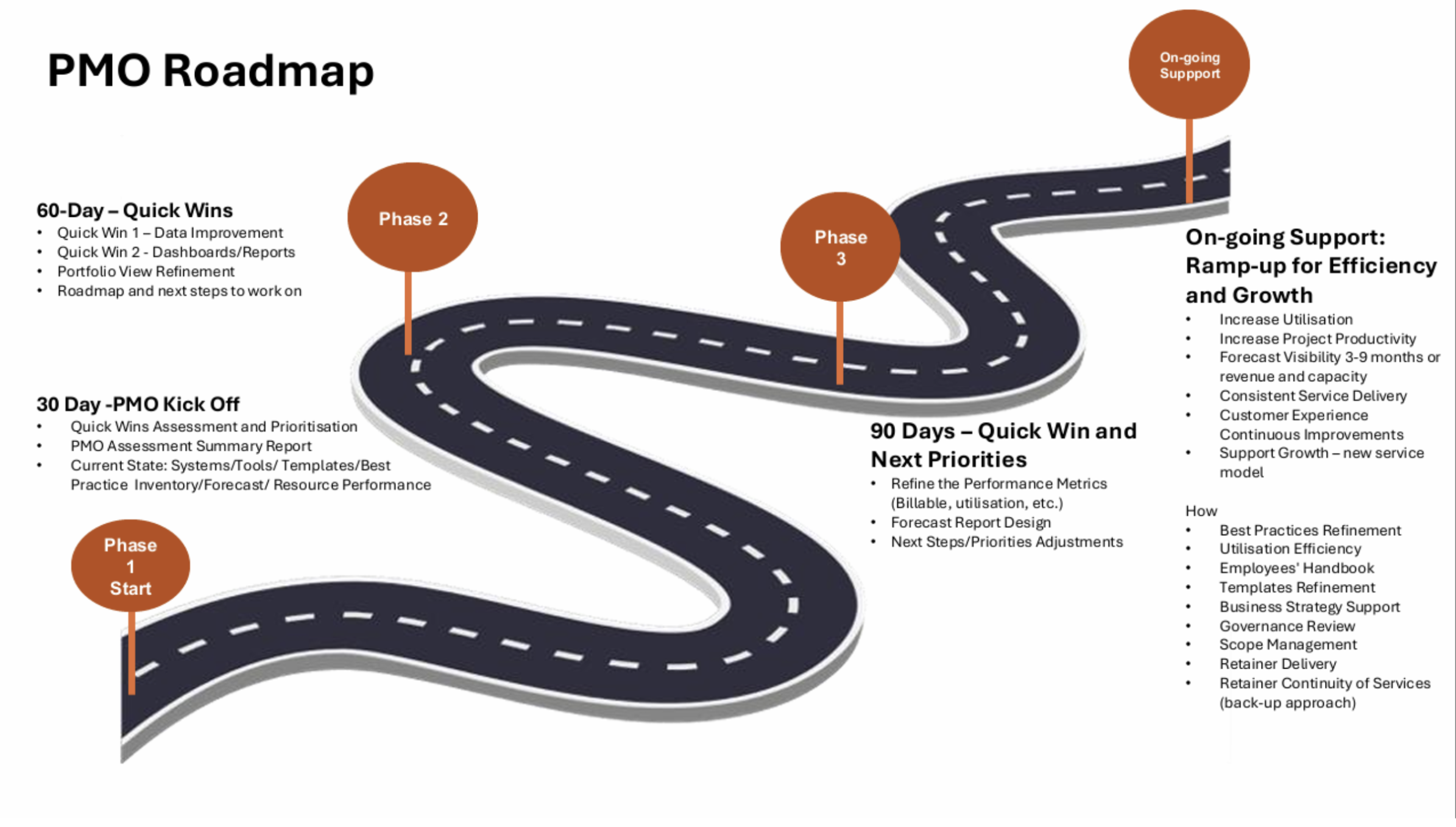
Alxemy implemented PMO Lite Setup tailored for Roger Roger to mitigate the key challenges and support the business growth using the template PMO roadmap below.

Key Results

  • Improved visibility of the current operational state across projects and delivery.
  • Delivery and implementation of three priority quick wins.
  • Establishment of best-practice processes to support ongoing data accuracy.
  • Development of a practical 30-60-90 day PMO roadmap.
  • Introduction of MVP reporting frameworks to support data-driven decision-making.
  • Greater consistency across project delivery and operational workflows

The Experience

First 30 Days – Building Momentum

From the start, the experience was highly collaborative, with clear direction and steady progress.

“Working with Cel and the Alxemy team from day one, we were moving forward.” “The whole process was really easy, structured, well planned, and incredibly clear.” “Communication was phenomenal. We always knew what was coming next.”  – Cory Gordon, Owner

    60 Days – Embedding the Structure

    By this stage, the operational structure was not only implemented but actively being adopted across the business.

    “The team is now taking this structure and bringing it across every single active project.” – Charlene Koekemoer, Head of Client Service

    The team began working more consistently, with clearer expectations and alignment across projects.

      90 Days – Confidence & Strategic Shift

      At the 90-day mark, the focus began shifting from foundational setup to long-term optimisation and strategic planning.

      “We were already in a really good spot from a foundational perspective, and now we’re moving into that post-foundation phase. We’re confident the data going in is accurate, which means we can step back, learn from it, and start applying those insights to our long-term strategy.”

      – Cory Gordon, Owner

      Wrap Up

      Alxemy’s approach extended beyond simply implementing PMO Lite. The team worked closely alongside Roger Roger Marketing to understand how the business operated, where operational friction existed, and what practical structures were needed to support sustainable growth.

      As Cory, Founder of Roger Roger Marketing, shared:

      “They didn’t just implement PMO, they really took the time to understand us as a business.”

      Roger Roger Marketing moved from a highly reactive, data-heavy environment to one with clearer priorities, improved operational visibility, stronger delivery alignment, and greater confidence in decision-making.

      With PMO Lite in place, the business now operates with:

      • Improved reporting confidence
      • Stronger governance and delivery consistency
      • Greater visibility across operational performance
      • More structured project and workflow management
      • A scalable operational foundation to support future growth

      This was not simply about implementing a PMO framework. It was about creating clarity, improving operational confidence, and enabling the business to make more informed strategic decisions as it continues to grow.

      Every growing business comes with its own operational complexity.


      Whether it is data accuracy, delivery consistency, or limited visibility across performance, our PMO service gives you the structure, clarity, and confidence to move forward.

      If you are planning your next phase of growth and want to talk through what good operational foundations look like, we are happy to have that conversation.

      Contact Us  Explore PMO Services

      Understanding the Proposed Changes to Parental Leave Payments and Leave Entitlements

      Understanding the Proposed Changes to Parental Leave Payments and Leave Entitlements

      parental leave changes

      Parental leave is one of the most personal transitions an employee navigates. It is also one of the areas where payroll errors cause the most harm. Underpaid holiday pay, incorrect leave balances, and payment rates that do not reflect an employee’s actual earnings are not abstract compliance problems. They affect real people at a financially and emotionally significant time.

      The Employment Leave Bill proposes to fix several of these issues. The changes affecting parental leave are specific, technical, and in some cases, operate on a different timeline to the rest of the Bill. This article explains what is proposed, how it works, and what it means for employers and their payroll systems.

      If passed into law, the new parental leave provisions will apply to any period of parental leave beginning on or after 1 July 2027. This date differs from many other parts of the Bill, which are expected to come into force two years after Royal Assent. That difference matters, and we will return to it at the end of this article.

      • Employees continue accruing leave during parental leave, based on their standard hours before they went on leave.
      • Temporary hour changes in the three months before parental leave will not affect leave accrual calculations.
      • The Bill removes the calculation method that allowed returning employees to receive zero holiday pay.
      • Parental leave payments will reflect 100% of actual weekly earnings before leave, across all employments.
      • The parental leave provisions commence 1 July 2027, a different and tighter timeline than the rest of the Bill.

      Leave Accrual During Parental Leave

      Employees on parental leave will remain entitled to annual leave as is the case presently,
      however, instead of becoming entitled to 4 weeks of annual leave on their anniversary date,
      they will accrue leave based on standard working hours.

      Under the proposed legislation, leave will accrue at a minimum rate of:

                | 0.0769 hours for every standard hour worked

      The key question is how “standard hours” are defined for an employee who is not currently
      working. The Bill introduces a clear answer.

      How Standard Hours Will Be Determined

      The employee’s leave accrual will be based on the standard hours they worked before commencing parental leave.

      This means:

      • If an employee had consistent standard hours before taking parental leave, those hours will continue to be used to calculate leave accrual while they are away.
      • Employees will continue accruing leave even though they are not physically working during their parental leave period.

      This change ensures continuity and prevents employees from being disadvantaged simply because they are temporarily absent from the workplace while caring for a child.

      Temporary Changes to Standard Hours Before Parental Leave

      The Bill also addresses a specific scenario: what happens when an employee temporarily changes their working hours shortly before commencing parental leave.

      Without a rule to address this, short-term changes to hours could unfairly skew leave calculations in either direction. The Bill closes that gap.

      When a Temporary Change Applies

      A temporary change is defined as:

      • an increase or decrease in standard hours; and
      • a change that remains in place for no longer than three months.

      If an employee and employer agree to a temporary change to standard hours within the three months before parental leave begins, the leave accrual calculation will instead be based on the employee’s standard hours immediately before the temporary change commenced.

      Why This Matters

      This provision prevents short-term adjustments to work hours from unfairly affecting leave entitlements.

      For example:

      • An employee who temporarily reduces hours due to pregnancy-related circumstances will not have their future leave accrual unfairly reduced.
      • Likewise, an employee temporarily increasing hours shortly before parental leave will not artificially inflate leave calculations.

      The intention is to ensure leave accrual reflects the employee’s genuine long-term working arrangement.

      Amendments to the Parental Leave and Employment Protection Act 1987

      Clauses 184 to 188 of the Employment Leave Bill introduce several amendments to the Parental Leave and Employment Protection Act 1987. These amendments primarily focus on correcting long-standing issues surrounding holiday pay and parental leave payments.

      The most significant of these is the removal of a calculation method that, in some circumstances, has resulted in employees receiving no holiday pay at all after returning from parental leave.

      Removal of Outdated Holiday Pay Provisions

      Changes Under Section 184

      Section 184 amends section 42 of the Parental Leave and Employment Protection Act by removing the words “and holiday pay.” As a result, the section title will now read:

                | Employer’s obligation in respect of remuneration

      In addition, section 42(2) will be repealed. This subsection previously required holiday pay to be calculated using the employee’s average weekly earnings.

      Why the Existing Rules Created Problems

      The existing calculation method often produced unfairly low holiday pay rates for employees returning from parental leave. This occurred because employees on parental leave typically have:

      • little or no gross earnings during the previous 6 to 12 months; and
      • reduced average weekly earnings as a result.

      Consequently, employees taking annual leave shortly after returning to work could receive significantly reduced holiday pay

      In Some Cases, the Rate Could Be Zero

      The problem was particularly severe for employees returning after 12 months of parental leave. If annual leave was taken during the first pay period after returning to work, the employee’s average weekly earnings could potentially be calculated at a rate of zero.

      This meant an employee could effectively receive no holiday pay despite returning to active employment. This is the kind of outcome the Bill is designed to prevent.

      The New Protection for Returning Employees

      The Employment Leave Bill addresses this issue by ensuring employees returning from parental leave are paid at least their base rate of pay for annual leave taken after their return. This amendment creates a fairer outcome and removes the risk of employees being financially disadvantaged immediately after parental leave. The same protection will also apply to holiday pay paid while an employee is on parental leave

      Repeal of Section 72

      Section 187 of the Employment Leave Bill repeals section 72 of the Parental Leave Act. This repeal aligns with the broader intention of removing outdated holiday pay rules that have created confusion and inconsistent outcomes for both employers and employees.

      Changes to the Calculation of Parental Leave Payments

      Another major reform relates to how parental leave payments themselves are calculated. It is important to note that this refers to Paid Parental Leave, which is managed by IRD. The changes here relate to how IRD will calculate the amount of the payment due to employees on paid parental leave.

      Because the comparison is based on actual earnings prior to the commencement of paid parental leave, it is important for employers to pay employees correctly for the hours worked before paid parental leave begins. Errors in that period will flow directly into the payment calculation.

      Amendment Under Section 186

      Section 186 replaces section 71M(1)(b)(i) and updates the method used to determine parental leave payments. Under the new approach, parental leave payments will be paid at the lesser of:


      • $788.66 (the current paid parental leave payment); or
      • the greater of: the employee’s ordinary weekly pay; or the average of the employee’s gross weekly earnings from all employments.

      A More Accurate Earnings Assessment

      The revised calculation method focuses on 100% of the employee’s weekly earnings before parental leave commenced. Importantly, it also considers earnings across all employments, rather than limiting calculations to a single role.

      This change is particularly beneficial for employees who:

      • work multiple jobs;
      • have variable income arrangements; or
      • receive fluctuating earnings.

      The goal is to create a more accurate reflection of an employee’s normal earnings before taking parental leave.

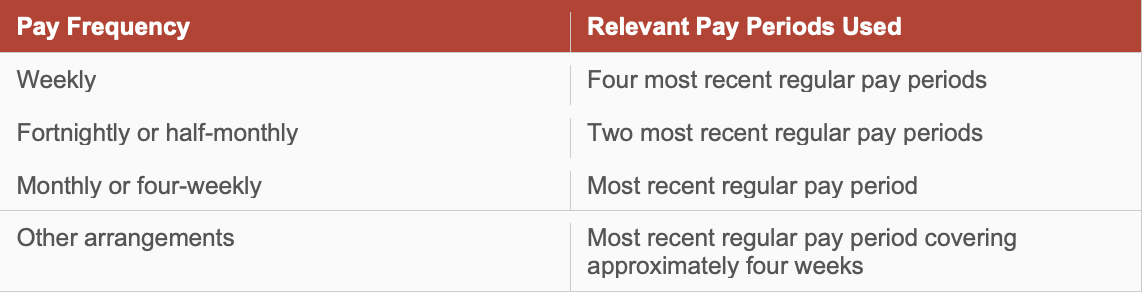
      New Definition of Relevant Pay Periods

      The Bill also introduces clear rules for determining which pay periods are used to calculate parental leave payments. These pay periods vary depending on how the employee is paid

        Implementation Date and Employer Readiness

        The new parental leave provisions are scheduled to take effect for any parental leave period beginning on or after 1 July 2027.

        This commencement date differs from many other parts of the Employment Leave Bill, which are expected to come into force two years after Royal Assent. As a result, employers may have a much shorter timeframe to prepare for these particular changes.

        That distinction is worth dwelling on. While much of the Employment Leave Bill conversation has focused on the two-year post-Royal Assent window, the parental leave changes operate on their own schedule. Organisations that assume they have the same preparation runway for all parts of the Bill may find themselves under-prepared for this section specifically.

        What Employers Will Need to Review

        If the Employment Leave Bill becomes law, employers will need to review and potentially update:


        • payroll systems;
        • leave calculation processes;
        • parental leave policies;
        • employment agreements; and
        • HR administration procedures.

        Because the changes affect both leave accrual and payment calculations, businesses will need to ensure their systems can accurately process the new rules before the commencement date. Early preparation will help employers avoid compliance issues and ensure employees receive their correct entitlements under the new legislation. (refer to our previous article: Employment Leave Bill: What You Can Do Now)

        What These Changes Mean in Practice

        The parental leave changes in the Employment Leave Bill are, at their core, about fairness. They close gaps that have existed for years: employees losing leave accrual while absent, employees receiving reduced or zero holiday pay on return, and payment calculations that do not reflect what an employee actually earns.

        For employers, the technical implications are real. Payroll systems will need to handle new accrual logic, a revised holiday pay method, and updated payment calculations. Employment agreements and parental leave policies will need to be reviewed against the new framework.

        The Bill has not yet passed into law. But the direction is clear, and the 1 July 2027 date for parental leave provisions gives less lead time than many organisations may expect.

        Understanding what is proposed is the first step. The next is assessing what it means for your specific systems, agreements, and workforce.

        If you would like to discuss how these changes affect your organisation, our team is available to help.

        Get in touch with Alxemy

        Key Takeaways:

        • Leave keeps accruing during parental leave. Employees will not lose leave entitlements simply because they are absent caring for a child. Accrual continues based on their pre-leave standard hours.
        • Temporary hour changes will not skew the calculation. If hours were adjusted within three months before parental leave, the calculation looks through that change to the hours that applied before it.
        • Zero-rate holiday pay on return will no longer be possible. Returning employees must be paid at least their base rate of pay for annual leave taken after parental leave ends. The same protection applies to holiday pay paid during parental leave.
        • Payment calculations will reflect all earnings, across all jobs. Employees working multiple roles will have their total gross weekly earnings considered, not just income from a single employer.
        • The 1 July 2027 date applies to parental leave specifically. This is not the same timeline as the rest of the Bill. Organisations need to treat parental leave readiness as a separate workstream with its own deadline.
        • Employer payroll accuracy before leave begins matters. Because parental leave payments are calculated on actual earnings prior to leave commencing, errors in that period will directly affect what IRD pays. Getting pre-leave pay right is part of compliance.
        Payroll Software vs Managed Payroll: Which Model Fits Your Organisation’s Growth Stage?

        Payroll Software vs Managed Payroll: Which Model Fits Your Organisation’s Growth Stage?

        What to do now?

        Managed payroll vs payroll software is one of the most consequential decisions a New Zealand business leader will make, and yet it rarely gets the strategic attention it deserves.

        For most New Zealand employers, payroll is far more than an administrative checkbox. It is the mechanism through which you honour your commitment to your people. Get it right, and it runs invisibly in the background. Get it wrong, and the consequences can be swift and serious: financial penalties, IRD scrutiny, and damaged employee trust.

        As your business grows, the question becomes unavoidable:

        Should payroll be managed internally with software or supported by an experienced payroll partner?

        There is no universal answer. The right model depends on your workforce size and complexity, your internal capability, your appetite for compliance risk, and the level of expert support you need when things get complicated.

        Here are three practical payroll models New Zealand businesses should consider, and the honest trade-offs that come with each.

        Option 1: In-House Payroll Software, For Businesses That Want Full Control

        Payroll software is often the first choice for businesses that want to keep payroll processing firmly in-house.

        Under this model, your internal team takes ownership of the full payroll cycle: entering hours and wage data, reviewing and approving pay runs, submitting payday filing to Inland Revenue, managing PAYE, KiwiSaver, and ESCT deductions, processing authorised employee deductions, and completing year-end reconciliations.

        Best For

        Smaller businesses with straightforward payroll structures and a capable internal administrator who understands New Zealand tax and employment law.

        What Works Well

        Managing payroll internally using software gives your organisation direct control over payroll timing, approvals, and internal processes. It can be cost-effective initially and typically includes employee self-service functionality, allowing staff to access payslips and update personal details without HR involvement.

        What to Watch Out For

        Software is a tool, not a substitute for expertise.

        Someone internally must stay current with PAYE and payday filing obligations, KiwiSaver and ESCT requirements, Holidays Act interpretation, and ongoing regulatory changes. System upgrades and configuration changes require continued investment and oversight.

        In New Zealand, employers carry full responsibility for accurate deductions and timely Inland Revenue reporting. Misconfiguration or misinterpretation, even when unintentional, can result in penalties, financial exposure, and reputational damage.

        IRD guidance for employers managing payroll tax obligations: ird.govt.nz/employing-staff/paying-staff

        Option 2: Managed Payroll Services, For Businesses That Value Expert Support

        Managed payroll services mean partnering with a professional payroll provider who manages your payroll processing on your behalf.

        Rather than relying on software alone, you gain access to a dedicated payroll team that runs your pay cycles, manages PAYE and statutory filing, provides compliance guidance, supports employee onboarding and contract changes, and is available to resolve issues and answer complex questions as they arise.

        Best For

        Businesses that prioritise operational continuity, reduced internal pressure, and access to experienced payroll professionals who know the New Zealand compliance landscape inside-out.

        What Works Well

        Managed payroll services reduce compliance exposure and ease the administrative burden on your internal team. They provide structured processes, professional oversight, and access to knowledgeable specialists when complex or sensitive situations arise. This gives you greater confidence that payroll obligations are being met accurately and consistently.

        What to Watch Out For

        The quality of managed payroll services depends entirely on the provider’s delivery model.

        Some large-scale providers operate with highly standardised processes designed for efficiency at volume. While this can create operational consistency, it can also result in a service experience that feels impersonal and transactional.

        A common pattern: senior expertise is visible during onboarding, but day-to-day processing is later handed to junior or high-volume teams. Over time, this can introduce consistency risks, particularly where payroll requires professional judgement, legislative interpretation, or careful handling of complex exceptions.

        New Zealand payroll is not simple. It involves nuanced application of employment legislation, Holidays Act interpretation, and the management of variable workforce structures. Without experienced oversight embedded throughout the operational layer, not just available as an escalation path, errors can accumulate quietly within repetitive processing environments.

        When evaluating managed payroll providers, look beyond cost and response times. Ask how senior expertise is integrated across the full payroll lifecycle, not just at the point of sale.

        Option 3: Hybrid Payroll, Software Plus Local Expertise

        Many growing businesses settle on a hybrid approach: modern payroll technology supported by experienced payroll professionals.

        Under this model, you benefit from the efficiency and automation of a contemporary payroll platform, while still having access to real people who can provide guidance, oversight, and practical advice when questions arise or complexity increases. Local service and responsive expertise are particularly valuable when regulatory interpretation or operational judgement is required.

        Best For

        Businesses scaling rapidly that want to retain visibility and internal control, while managing more complex payroll environments. This includes businesses with multiple pay types, a mix of hourly and salaried employees, integrated time and attendance systems, or structured allowance administration.

        What Works Well

        The hybrid model balances technology-driven efficiency with human expertise. It is well-suited to businesses that are outgrowing a purely DIY approach but are not yet ready or willing to hand over full payroll management to an external provider.

        What to Watch Out For

        Under a hybrid model, your business typically remains the system owner. That means ongoing responsibility for software licensing, configuration integrity, security settings, and upgrade management. All of which require continued attention as your business grows and legislation evolves.

        Payroll platforms are developing rapidly, particularly with the acceleration of AI-enabled functionality. Rather than viewing this as a risk, the key is ensuring you have the right support in place to make the most of your investment, both now and as the platform matures.

        This is where Alxemy’s approach is different. We do not simply manage your payroll and step away. Our team can work alongside you to support system configuration, manage upgrades, and ensure your platform continues to perform accurately as regulatory requirements change. You get the efficiency of modern payroll technology and the reassurance of experienced professionals who know how to keep it running at its best.

        For businesses that have made a significant investment in payroll software, this kind of ongoing partnership means your system remains an asset, not a liability.

        Key Takeaways:

        • Payroll software gives you control, but someone internally must own the compliance responsibility that comes with it.
        • Managed payroll services reduce your compliance exposure and free your team to focus on what they do best.
        • Not all managed payroll providers are equal, ask how senior expertise is embedded throughout delivery, not just during onboarding.
        • A hybrid payroll model can balance technology efficiency with human expertise, but your business remains the system owner.
        • You don’t need to outsource everything. Targeted expertise extension during peak periods can significantly reduce your compliance risk.
        Does Fiscal Year End Really Matter for PMO?

        Does Fiscal Year End Really Matter for PMO?

        fiscal year end<br />

        Short answer: yes, and not just for the reasons you might think. Fiscal year end is the moment where delivery, funding, governance, and strategy all collide, and where the value of a strong PMO becomes impossible to ignore. Miss it, and the cost is not just a difficult close. It is a slower, harder start to the year that follows.

        Identify Standard Working Hours for Your Employees

        $109 million lost for every $1 billion invested in projects due to poor performance. That is the reality, according to PMI. And 65% of projects fail to meet their original goals.

        These are not abstract statistics. They are the result of pressure points that compound over time — and fiscal year end is the biggest one.

        It is the moment when every structural weakness in your delivery environment becomes visible at the same time. Decisions get made with incomplete information. Work gets stopped or continued for the wrong reasons. Teams absorb pressure that carries directly into the year ahead.

        The organisations that come through it well are not the ones with the most resources. They are the ones with the clearest data, the strongest governance, and a delivery environment built to hold under pressure.

        Funding Drives Decisions and Someone Needs to Make Sense of It

        Are you getting value from what you are spending?

        At fiscal year end, that question gets asked at every level of the organisation. Unused funds may be lost. Overspend gets questioned. New initiatives depend on funding that is yet to be approved.

        If no one can answer clearly, decisions default to assumption. Money flows out, work continues, and the organisation moves into the next year without knowing what it got for its investment.

        A PMO changes that by:

        • Aligning spend to real delivery progress, not estimates or percentage complete figures
        • Providing accurate forecasting so there are no surprises in the final quarter
        • Tying funding to outcomes that can be clearly articulated and defended

        The result is an organisation that closes the year with confidence rather than questions.

          The Biggest Decisions of the Year Happen Here

          Only 55% of organisations have access to real-time KPIs, according to Wellingtone. The rest are making critical portfolio decisions without reliable data.

          At fiscal year end, that gap is most expensive. This is when organisations decide what to stop, what to continue, and what to invest in next. These are the most consequential decisions of the year and they should be driven by evidence, not instinct.

          When performance data is incomplete or arrives too late, decisions get made based on habit or whoever makes the loudest case. Work that should stop continues. Opportunities that deserve investment get overlooked.

          A PMO gives every leader access to the same reliable portfolio data, turning fiscal year end decision-making from a political exercise into a strategic one.

            Reporting Under Pressure Reveals What Is Actually Working

            Picture this. It is the final weeks of the financial year. Leadership needs a consolidated view of delivery performance across every programme. Finance needs numbers that reconcile with what is in the system. The board wants to know what was delivered against what was promised.

            And 50% of project teams spend one or more days per week manually pulling together reports instead of delivering. That figure comes from Workamajig, and it is more common than most organisations want to admit.

            Inconsistent reporting does not just slow things down. It erodes confidence in the data. And without confidence in the data, decisions slow down or get made without the information they need.

            A PMO maintains reporting standards as a year-round discipline, so when fiscal year end arrives, the data is already there, already clean, and already ready.

              A Honest Note on PMO Value

              Not every PMO delivers on its promise. Executives who have lived through a PMO that added process without adding value will recognise this tension immediately, and they are right to.

              A PMO that generates reporting for the sake of reporting, or enforces governance that slows delivery down without improving outcomes, is not a strategic asset. It is overhead.

              The question is not whether you have a PMO. It is whether your PMO is structured to deliver visibility and control that actually changes decisions.

              At fiscal year end, that distinction becomes clear very quickly. The organisations that come through it well have a PMO that is embedded in delivery, not layered on top of it.

                Delivery Risk Is Highest When Capacity Is Lowest

                Here is what fiscal year end looks like when it goes wrong.

                Milestones get accelerated to meet year end targets. Teams are pulled across multiple priorities at the same time. Business-as-usual demands spike. Key people are stretched beyond capacity.

                Then the delays start. Quality drops. Issues that should have been caught early surface too late to resolve cleanly. And the problems that emerge in the final quarter carry directly into the following year, compounding pressure on a team that never had time to recover.

                Active risk management and capacity balancing across the portfolio is not a nice-to-have at this point. It is the difference between a team that arrives at the new year ready to deliver and one that is already behind.

                  How You Close the Year Shapes How You Start the Next One

                  A clean close looks like this: Clear outcomes documented. Issues resolved or formally transitioned. Priorities set for the year ahead. Governance in place before day one of the new financial year. Teams that know exactly what they are working on and why.

                  A messy close looks like this: Unresolved issues carried over with no clear owner. Priorities still being debated weeks into the new year. Teams starting behind because last year never properly finished.

                  High-performing organisations with proven project management practices meet their original goals 2.5 times more often than those without, according to PMI. That gap does not happen by accident. It is the result of structure and discipline that starts well before fiscal year end and carries through it cleanly.

                    What This Means for Your Organisation

                    Fiscal year end is not a checkpoint. It is a defining moment for any organisation running complex programmes and projects.

                    The organisations that come through it well are not the ones with the most resources. They are the ones with the clearest data, the strongest governance, and a delivery environment that gives every leader the visibility they need to make the right calls at the right time.

                    The difference between a controlled close and a costly one is not luck. It is structure.

                    Every organisation reaches fiscal year end with a different set of pressure.

                    Alxemy embeds experienced PMO professionals who bring immediate structure, improve delivery and financial alignment, and give your leadership team the visibility to close the year strong and start the next one ahead.

                    Talk to Alxemy about what the right PMO support looks like for your organisation.

                    Contact Us   View PMO Services

                    Frequently Asked Questions

                    What makes fiscal year end different from any other reporting period?

                    It is the one moment where funding decisions, portfolio priorities, delivery performance, and governance all land at the same time. Every other reporting period is a checkpoint. Fiscal year end is a reckoning.

                    Our projects run year-round. Why does fiscal year end create extra pressure?

                    Because the decisions made at year end affect everything that follows. Budgets get confirmed or cut. Programmes get stopped or continued. If your PMO cannot provide clear data at this moment, those decisions get made without the information they need.

                    What does a PMO actually do at fiscal year end that we could not manage without one?

                    It stops the scramble. Without a PMO, year end typically means teams pulling together last-minute reporting, numbers that do not match, and leadership making decisions on incomplete information. A PMO prevents that from happening in the first place.

                    When should we bring in PMO support ahead of fiscal year end?

                    Earlier than you think. By the time year end arrives, the window to fix reporting gaps and stabilise delivery has already closed. One quarter ahead is the minimum. Earlier is better.

                    Key Takeaways:

                    • Funding clarity — A PMO connects spend to outcomes so every leader knows what their investment is delivering
                    • Better decisions — Reliable portfolio data replaces assumption and instinct with evidence at the most important moment of the year
                    • Reporting confidence — Consistent, audit-ready reporting maintained as a year-round discipline, not a last-minute exercise
                    • Delivery stability — Active risk management and capacity balancing keeps delivery on track when pressure is at its peak
                    • Strong starts — A clean, well-governed close creates the conditions for fast and confident execution in the year ahead
                    Employment Leave Bill: What You Can Do Now

                    Employment Leave Bill: What You Can Do Now

                    What to do now?

                    The Employment Leave Bill is making its way through Parliament and, while it has not yet passed into law by receiving Royal Assent, there are practical steps organisations can take now to prepare.

                    Taking action early can help ensure the right foundations are in place should the Bill become law, reducing the risk of rushed decisions, system disruption, and compliance challenges later.

                    This article outlines some of the key actions employers can take now to assess readiness and begin planning for change.


                    Identify Standard Working Hours for Your Employees

                    The basis of the Employment Leave Bill is that leave is accrued based on standard working hours.

                    These are defined as the hours an employee is required to work under their employment agreement and for which the employer must pay them. Leave accrual continues during periods of paid leave, parental leave, volunteer leave, and jury leave, but not during periods of unpaid leave.

                    If there are no standard hours, the employee and employer can agree on a notional roster.

                    What to do now: Start looking at your rosters. Identify where hours may need to be further defined, or where a notional roster may be needed.

                    Identify Additional Hours

                    Additional hours are hours worked over and above an employee’s standard hours.

                    This is where the agreement of standard working hours becomes important. Hours worked above standard will need to be paid at the base hourly rate plus 12.5%. This rate of pay is referred to as the Leave Compensation Payment (LCP).

                    An employer and employee can also agree to accrue PAL, Purported Annual Leave. This relates to an employer’s liability where leave is accrued instead of the employee receiving LCP.

                    Casual Employees

                    Consider reviewing your casual employees,  are these genuine casuals?

                    Once the Employment Leave Bill becomes law, casuals will be paid the LCP rate of 12.5% on worked hours, rather than the current 8%. Alternatively, casual employees can accrue Purported Annual Leave as above.

                    Definition of Otherwise Working Day

                    Currently there is no definition of otherwise working day (OWD) within the Holidays Act. This has resulted in ambiguity around how to determine whether a public holiday was an otherwise working day for an employee.

                    The Employment Leave Bill sets the determination of OWD as an employee having worked on the same day of the week on at least 50% of the last 13 weeks.

                    Because there is no current legislation to adhere to regarding OWD, this is one of the few areas where you can configure your system now, and have the determination in place when the Bill becomes law.

                    What to do now: Check whether your system can automate this. If not, why not?

                    Parental Leave Changes

                    The proposed changes to parental leave will be effective for any parental leave applications on or after 1 July 2027.

                    This is the one change that is not effective two years after Royal Assent, it applies in a shorter timeframe. This means the configuration for parental leave will need to be updated sooner than the rest of the Bill’s provisions, and will need to work alongside the current provisions of the Holidays Act during the two years after Royal Assent.

                    More Detail Coming: A follow-up article on the details of the parental leave changes is coming soon.

                    Provision of Pay Statements

                    Once the new Act is in place, there will be a legislative requirement to provide employees with pay statements.

                    This has not been in legislation before, but it is considered best practice and most payroll systems already provide payslips. However, with the Bill defining what must appear on a pay statement, it is worth checking what your current payslip includes, and working with your software provider to add anything that is missing now.

                    Refer to section 130A of the Bill for the full requirements.

                    Obfuscation of Family Violence Leave

                    The Bill introduces a change to how family violence leave is recorded on pay statements.

                    Many organisations already obfuscate the term on payslips, but this will now be legislated. Family violence leave will need to be recorded as a non-identifiable component of the employee’s pay.

                    What to do now: If your system is not already doing this, now is a good time to make the change.

                    Remediation Under the Holidays Act 2003

                    Schedule 3 of the Employment Leave Bill makes provisions for a remediation process under the Holidays Act.

                    This means that if the Employment Leave Bill becomes law, employers cannot avoid their obligations under the Holidays Act 2003 while waiting for the Employment Leave Act to come into effect. If your system is not currently compliant with the Holidays Act, that still needs to be addressed now.

                    The Employment Leave Bill becoming law will not protect you from a future remediation process.

                    And yes, once you have addressed your Holidays Act compliance, you will then need to change again when the Employment Leave Act comes into force. However, the Employment Leave Bill does detail the calculations required to convert weeks and days into hours.

                    Important: If your system is not already operating in weeks and days, you will be in contravention of this part of the Bill. You will not be starting from the same platform required for the conversion as stated in the Bill.

                    Ready before the Bill lands?

                    Whether you are working through rosters, reviewing casual arrangements, or trying to understand what the Employment Leave Bill means for your systems and people, Alxemy can help you work through it.

                    If you would like to talk through where your organisation stands, we are happy to have that conversation.

                    Talk to our team  View Payroll Services


                    In Summary

                    Waiting for the Employment Leave Bill to become law before you act is not a strategy. It is a risk.

                    The time to get your systems, rosters, and processes in order is now, while you still have the runway to do it properly.

                    The changes introduced by the Bill are significant. Leave accrual based on standard hours, Leave Cash-up Payment (LCP) on additional hours, a legislated Ordinary Working Day (OWD) test, and parental leave changes effective from 1 July 2027 all carry system, process, and people implications that take time to work through.

                    For organisations carrying Holidays Act non-compliance into this transition, the stakes are even higher. The Bill makes it clear that past obligations remain. Remediation is not optional, and the Employment Leave Act coming into force will not change that.

                    The organisations that navigate this transition well will be those that start early, stay informed, and treat preparation as an ongoing discipline rather than a last-minute project.

                    If you have not yet read Article 1: Holidays Act 2003 vs Employment Leave Bill: What Is Actually Changing, start there for a grounding in the key reforms.

                    In Article 3 of this series, we will take a closer look at the proposed parental leave changes and what they may mean for employers, payroll teams, and employees.

                    Ready to prepare your organisation for the Employment Leave Bill? Talk to Alxemy today.


                    Key Takeaways:

                    • Standard working hours — Review your rosters now and identify where hours need to be defined or where a notional roster may be required
                    • Additional hours — Hours worked above standard will attract a Leave Compensation Payment (LCP) of 12.5% on top of the base hourly rate
                    • Casual employees — Review whether your casuals are genuine. The LCP rate moves from 8% to 12.5% once the Bill becomes law
                    • Otherwise Working Day (OWD) — One of the few areas you can configure your system now. The test is 50% of the same day worked across the last 13 weeks
                    • Parental leave — Changes apply to applications on or after 1 July 2027 — sooner than the rest of the Bill. Configuration will need to happen ahead of the broader transition
                    • Pay statements — Check your current payslip against section 130A of the Bill and work with your provider to close any gaps now
                    • Family violence leave — Must be recorded as a non-identifiable component on pay statements. If your system is not doing this already, change it now